In the era of digital transformation, the value of enterprise data isn’t in how much we collect it’s in how well we can understand, trust, and activate it. For decades, SAP systems have been the backbone of global operations, managing everything from finance and logistics to HR and procurement. Yet as the enterprise landscape expanded with cloud-native tools, IoT, and AI entering the picture many organisations found themselves in a familiar trap: fragmented data and disconnected insights.
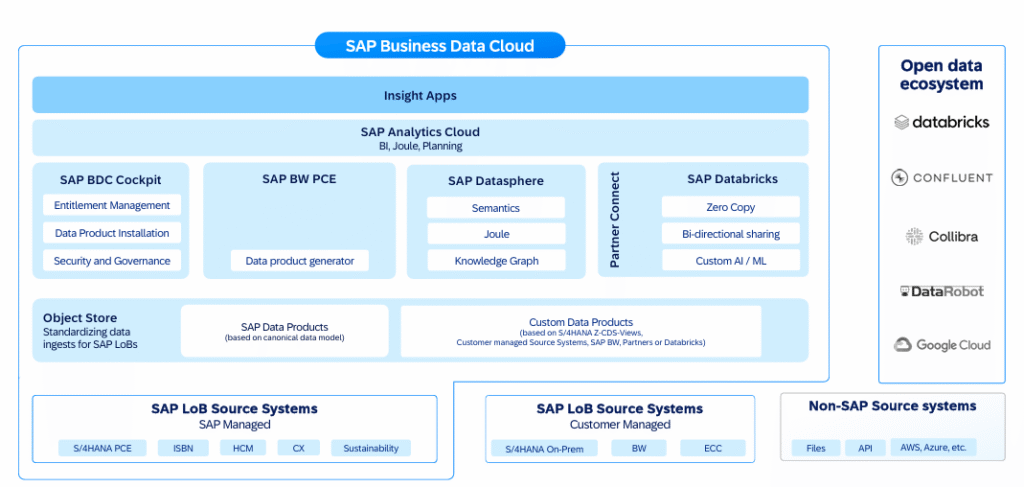
This is where SAP Business Data Cloud (BDC) steps in. It’s not just another cloud platform it’s a strategic layer designed to unify SAP and non-SAP data with business context intact, enabling analytics, AI, and planning to operate on a common foundation of truth.
At its core, BDC is part of SAP’s new data vision “to make every piece of business data more valuable by connecting it with meaning.” Unlike traditional data lakes or warehouses, which focus primarily on storage and performance, BDC focuses on contextualisation and governance. It allows enterprises to bring together data from multiple sources (SAP S/4HANA, third-party apps, external APIs) while preserving semantics such as cost centers, profit margins, and supply hierarchies.
SAP explains: “With Business Data Cloud, organisations can extend the value of SAP data by integrating it seamlessly with other data in an open, scalable environment.” — SAP Business Data Cloud Overview
This is especially critical for AI-driven use cases. A predictive model is only as smart as the context it understands. BDC ensures that when AI analyses “revenue,” “inventory,” or “customer churn,” those terms reflect real business meaning, not just raw numbers.
Moreover, BDC integrates natively with SAP Datasphere, ensuring that the semantic richness of SAP applications flows into analytical and AI platforms without requiring data replication or complex pipelines.
For UK enterprises, this has become particularly relevant. Retailers, manufacturers, and financial institutions are increasingly seeking to combine SAP data with cloud-based analytics and external signals (like IoT or market data) to enhance forecasting and scenario planning.
In short, SAP Business Data Cloud represents the new foundation for the intelligent enterprise one where data is no longer siloed but interconnected, trusted, and actionable. It bridges the gap between operational precision and analytical innovation.
In the next part of this series, we’ll explore how BDC connects with SAP Datasphere and Databricks, and how that partnership transforms enterprise data into a truly intelligent ecosystem.
Sama Huseynova Kibar