While SAP Business Data Cloud defines the strategy, its power truly unfolds through integration particularly with SAP Datasphere and Databricks. Together, these technologies create a data ecosystem where trust, openness, and intelligence coexist — without the heavy lifting of traditional data engineering.
The collaboration between SAP and Databricks marks a fundamental shift in enterprise data architecture. SAP Datasphere provides a semantic layer that translates complex SAP structures into understandable business language. Databricks, on the other hand, offers an open Lakehouse architecture for scalable data processing, machine learning, and AI.
Through their 2025 strategic partnership part of the new SAP Databricks Connector the two platforms now share data bi-directionally and securely, using Delta Sharing.
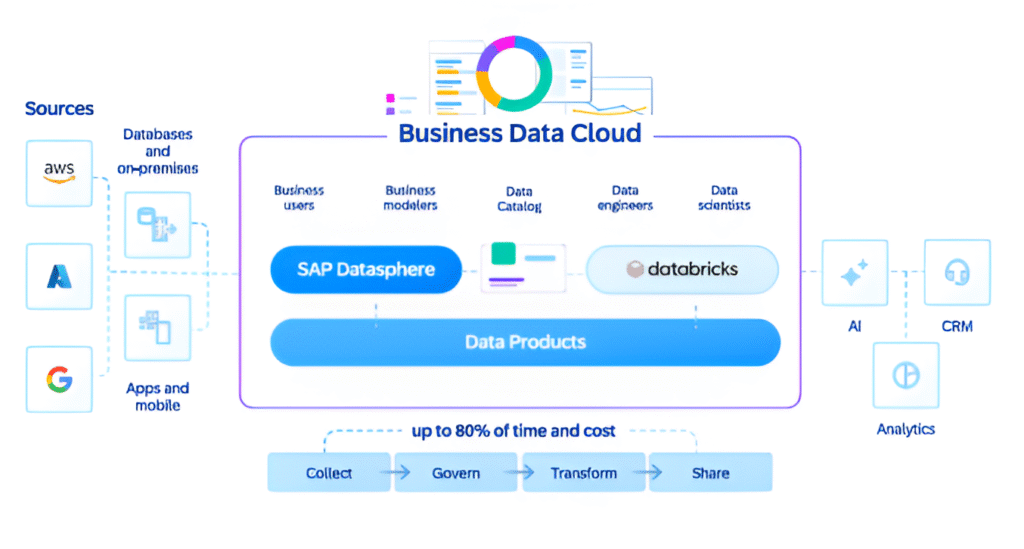
This means data doesn’t need to be exported, duplicated, or transformed endlessly. Instead, SAP data remains governed in BDC and Datasphere, while Databricks accesses it directly for analytics, ML, or advanced transformations.
SAP summarises it well:
“This collaboration bridges SAP business data with Databricks’ open platform for data and AI, accelerating innovation across the enterprise.” SAP & Databricks Announcement
From a technical perspective, the benefits are clear:
- Zero-copy access – analytics on live SAP data, no latency or replication.
- Unified governance – SAP security and lineage extend to Databricks.
- AI-ready data – semantic context travels with the data into the Lakehouse.
- Operational efficiency – fewer ETL jobs, reduced cost, simplified architecture.
For UK organisations, this architecture is already redefining best practices. A leading energy provider, for instance, uses SAP Datasphere + Databricks to analyse operational data from SAP S/4HANA and external IoT feeds predicting maintenance needs and optimising field operations in real-time. Public sector agencies, too, have reduced reporting latency from days to hours by moving from manual SAP extracts to governed, federated access through BDC and Databricks.
This integration is more than a technology upgrade it’s a new model for enterprise intelligence.
By connecting BDC, Datasphere, and Databricks, organisations gain agility, consistency, and the ability to activate their business data for AI and innovation at scale.
In the next part, we’ll explore how companies can strategically position themselves to leverage this ecosystem and what steps to take to future-proof their data architecture.
Sama Huseynova Kibar